Monday, January 6, 2014

Luke Bretherton Delivers Another Strike

The "hits" just keep on coming.

Luke Bretherton delivers another strike on the ABC religion blog (http://www.abc.net.au/religion/articles/2014/01/06/3921285.htm).  I am totally sympathetic with the idea that drug use is inherently conservative, conformist, and congenial to the values of late modern, technocratic culture.

I wonder what he'd say about the use of typically ampliative drugs for therapeutic purposes where the high actually represents part of the therapy.  It may be that, as he says, drugs manufacture and bureaucratize experience in a way that is not fully human; on the other hand, aren't some experiences too much to bear?  Cancer patients report extreme alleviation of their own suffering by marijuana use.  Couldn't it be, analogously, that late modern culture presents some people with an experiential load that is so dehumanizing that drug use is still better than the alternative?  Sure, experience that is packaged and doled out chemically may be subhuman, but in some cases maybe it's better than the kafkesque realities of some whose experiene is "owned" and doled out to them by those who actively do them harm?

Even in prison, there are gradations of incarceration.  The basketball court on the yard probably feels pretty free compared to the solitary block.

Ya'll read it and tell me whatcha think!

Friday, December 13, 2013

That it may go well with you...

Had a decent chat with a friend lately who is recovering from a hard case of evangelical kitsch.  He was talking about going to see Passion as a sociological experiment.  I asked whether he thought he could still see God at work in Passion.  He has concluded that the entire evangelical shibboleth of identifying God's movement (e.g. "God really moved" at this service, "God is really doing cool stuff at this church," etc...) is to be abandoned posthaste.

For evangelicals, this sight has all the cultural
currency of high-waisted jeans and tucked in v-necks

I found myself thinking of the Biblical command to honor one's parents (Ex 20:12).  Paul glosses this in Ephesians with the note that it is "the first command with a promise."  It is never said that the honor commanded is conditional, as in "honor them if they're good enough."  No:  the honor of one's children is a means of God's grace to parents in a way analogous to the love, affirmation, and blessing of parents for their children.  It is by our honor of our parents that we come to maturity and fulfillment of what God calls people to be.  In this way, to dishonor one's parents is to tie oneself in unhealthy ways to them and (ironically) to the failures that we despise in the first place.  Each act of dishonor yokes us closer to the things we dislike.  In the divine economy, one grows past the failures of the previous generation by honoring them, by receiving the gifts that have come down through them, and forgiving as many mistakes as there may be.

Oh yeah, we're hip like that.
None of this, it should be said, precludes telling the truth about one's parents.  My father abused and beat me for most of my life.  The command to honor one's parents does not prevent me from saying he did this.  Nor does the fact that he did, however, determine my ability to honor him.  By God's grace, I have won through to a place where I can be grateful for the gifts that are mine because I am my father's son, even if he did not cooperate in the gift of them to me.

I believe that it is my grateful receipt of these gifts to me that honors an undeserving father.  In the same way, what I wanted to counsel my friend was that we only grow greater than our parents in our honor of them.  Evangelicalism's excesses are so obvious to my friend.  Its historical amnesia, its unawareness of its own role in perpetuating some of our culture's injustices, and its unwillingness to be challenged by the wider church, for many former evangelicals, give the lie to its sense of the felt nearness of God.  But we grow past these things not by our disdain but by our honor.  Things I have received from evangelicalism:  1)  a love for and devotion to the Scriptures; 2)  a sense that God's work in the world should create a here-and-now community (this is the evangelical ecclesiology; Catholicism for all its insistence upon the visible Church has an actual life together that repeatedly challenges evangelicals when they convert);  3)  a robust sense of the summons to proclaim the Gospel in the world; and 4) an expectation that the God to whom we pray is a God from whom we can expect action.  I have seen the finger of God miraculously at work; it was evangelicals who taught me to ask for that and expect that I might see it.  These are precious gifts–the kind of thing one should be grateful to receive.  A mature child loves and cherishes her parents for the gifts they have been to her without legitimizing their failures.  So, friend, disdain your heritage if you will, but all you are doing is lashing yourself to the things you despise; if Genesis is a faithful witness, failure to honor one's parents pretty much dooms one to repeat their mistakes in another key.  Honor an undeserving parent, and you not only grow beyond your father's gates, but you become part of how God redeems your father's old age.  Thus, by God's good grace, it goes well with you in the land you inherit from your father.

Monday, August 5, 2013

A Review of Craig Keener's New Book!

Miracles:  They're Not Just for Fundies Anymore

Asbury's Craig Keener has written some decent NT commentaries.  But it is 2011's Miracles:  The Credibility of the New Testament Evidence, a two-volume tour-de-force with refreshingly little to say about the New Testament itself, that should give him real street cred as a world-class scholar.

You ain't gotta be TBN:  even the
Baptists are getting in on this action!!!
Hold the phone...refreshingly?

Yes!  Keener has written some decent commentaries on some Gospel narratives and on Acts, and he knows how these things usually get hashed out.  This or that account is brought up and its "form" is analyzed, and it is beaten like a waterboarded witness until it admits what "layers" it supposedly contains, add in the requisite parallelomania and you've got yourself a story completely evacuated of history by the historians.

Keener has paid the price in reviews for refusing to play by these rules, and so in this book, I suspect he knew there would need to be some deeper spade work done.  It's kind of like writing a prequel after the main story, except with way better results than LucasFilm ever got!

This is a book whose proper genre ought to be something like "Epistemology of New Testament Studies."  His target is none of the foxes who have nibbled various parts of the New Testament vineyard.  No!  C Keener comes loaded for bear in this one.  Modernity has two great commandments:  thou shalt not believe in an intervening God, and the second is like unto it:  thou shalt disavow any purported working of that God as against the "universal human testimony." As all people know, the universe works by immutable
What has two thumbs, a brass toe, and a bit
of nostalgia for his toga-draped fraternity
keggers?  
chains of cause and effect.  Of course the muscle in this modernist mafia is the Great Brass-Toed Philosopher himself.  It is David Hume who insisted that humanity spoke with one voice in a great cosmic denial of any miraculous activity.  And this second table of the modern torah has underwritten, as torahs are meant to do, an entire way of thinking about the Bible.  Thus, Bultmann insisted that wherever miracles were related in the Gospels and Acts, for example, it was clear that there was no real testimony present but rather the accretions of a subsequent "Christ-tradition" to the pristine narratives about Jesus.

Keener responds appropriately with a two-part thesis, one to overturn each of the two tables.  The first, covered in chapters 7-12, completely refutes the Hume's argument from the so-called universal denial of miracles.  There are, Keener notes, multitudes of Christians around the world who claim to have seen or received miraculous healing, provision, or even miraculous movements in nature.  He documents just a few dozen of the hundreds to which people he knows to be reliable might give firsthand or eyewitness testimony (even admits he didn't try that hard!).  The book could have been enormous.  Many of the healing stories are accompanied by medical evaluation and confirmation, although many more are not.  In either case, Keener admits to being unqualified for the job of evaluating medical data.  He does, however, have plenty of testimony from doctors who are themselves qualified and have evaluated the data in many cases.  These cases, however, are much fewer due to the fact that many of the supposed miracles to the testimony of which Keener has access have occurred in places where medical evaluation was not possible.  But the many cases where it is available, he argues, create a plausibility structure in which the other kinds of events not only make sense, but bear analogy to the ones for which he can claim some kind of medical validation.
Any fair-minded reader will emerge from those 6 chapters (the heart of the book) with no doubt about whether Hume was right.  Key for the argument Keener makes is that of the dozens of purported miracles he cites and documents, none of them need to be true for it still to be the case that Hume was wrong.  There is an enormous amount of human testimony to the miraculous, correct or no.  The question of whether any of that testimony concerns actual miracles is, he concedes, a more difficult one, although not an impossible one.

--"You think anyone will buy Keener's argument?"
--"It would take a miracle!"
"Hume-perdink, Hume-perdink, Hume-perdink!"
--"You promised never to say that name!"
And with the question of the truth of the accounts he relates, Keener takes aim at the first table:  for only a very small fraction of these accounts need to be true in order for there to be compelling evidence for divine action in the world.  The book's later chapters, 13-15, deal specifically with these questions by adducing limiting cases.  That is, if we grant the widest possible scope to possible alternative explanations for many of the miracles and healings (he admits that some of the testimonies he documents may indeed be explicable by natural causes--though far fewer than one might think), there are still testimonies (and plenty of them!) of incredible, medically inexplicable events:  the removal of cataracts from eyes, the instant restoration of vision to those with severed optic nerves, and even the restoration to life of those who have been dead for far too long to hope for that.  He documents one case of a child who was dead for three hours but was restored to health by prayer and lives on to the present day (she is his sister-in-law) in great health.  Six minutes without oxygen would generally leave a person with massive, crippling brain damage even if they were to be restored.  That this event could have occurred naturally has a probability of very near zero.  That this and many other such "anomalies" occur in response to prayer (far more frequently than without prayer) creates a pressure that starts to suggest, over the course of the book, that it would be more remarkable that these events were not divine in origin than that they were.

It is difficult to argue with the testimony of an eyewitness who is still living to events concerning a child, restored from death, who is also still living.  It is difficult, but not impossible.  The book's last 3 chapters do not in any sense create a deductive argument for the existence of divine action (or existence, for that matter).  But they do suggest a cumulative case argument whose conclusion seems to explain these testimonies better than any other could.  And thus, the final chapters connect very nicely to the book's first six chapters to form what I would call the "head" of the book (the middle chapters, as suggested before, being its "heart").  These early chapters address the particular phenomena testified to in the biblical texts, phenomena which are shown by chapters 13ff. to be analogous to those about which Keener has collected testimony.  The early chapters also address Hume's skepticism head-on to see whether it works intrinsically as a theory, although it is here, I suspect that the book will run into the most problems with those who specialize in Hume's thought and see it as definitive on these questions.  Keener is on much firmer ground where he simply disputes the claim and (by any measure I can conceive of) debunks it.  These early chapters, then, along with the final chapters, aim to give modern readers of the bible nothing less than a brain transplant (or perhaps just a renewed mind).  The modern reader of the biblical text, pressed to the question by the weight of so much testimony, is invited to examine the Bible afresh and see whether or not similar testimonies are to be found there.

(One side note:  In light of these testimonies, chapter 10 is a particularly bright gem, in which Keener treats some of the miraculous testimony in the history of the Church.  The book would have been pulled out of shape by too deep a look into this, but since to my mind Church history suffers from the same modern pathogen as NT history does, it was refreshing to see Keener turning his gaze there even for a moment.  I certainly wonder, for example, how St. Gregory's Life of Benedict would fare under scholarly revisitation after the pallet-cleansing Keener aims to give.).

Keener succeeds admirably in his set aim, but I think the book merits a stronger statement still.  The book stands as an admirable analysis and retooling of the epistemological scaffolding of much New Testament scholarship.  It is, to repeat, most fittingly described as a contribution to the epistemology of Biblical Studies.  Yet it might be suggested that the book does not merely aim to testify about miracles, but to press the problem of accounting for all of this testimony.  Fabrication or deceit will not do, for, as Keener notes, most of his witnesses have absolutely not motive for it.  Additionally, many of them are personally known to him and he therefore has reason to trust them (his wife's family, for example).  He has, in addition, his own testimony to give.  But if these testimonies cannot be dispensed with as deceptions, and if they cannot be sufficiently accounted for by many of the alternative explanations he proposes (histeria, hypnosis, suggestion, psychosomata, etc...), then how is one to account for them?  And it is to this question that I think the book ultimately leads, even if that question is, as Keener suggests, his secondary question.

Indeed, It seems to me that Keener's book suggests a plausibility structure with which one can read the New Testament afresh.  But the weight of Keener's testimony does not merely rest at the point of making the New Testament plausible.  Indeed, it may serve to re-enchant the world, such that readers are now forced to find a paradigm to explain a world they did not know they lived in.  The fact of so many multiplied accounts of healing on the heels of Christian prayer may open up the New Testament not only as history, but as the history in which other histories begin to make sense.  And in this way, perhaps we may be brought once again to the one whose stories the Gospels tell, to be addressed again by Him, surely itself another miracle worth witnessing to.


Wednesday, December 19, 2012

Second(ary) Amendment


The second amendment:

A well regulated militia being necessary to the security of a free state, the right of the people to kTheTheeep afringed.

About this, notice two things:  context and contingency.

1)  Context:  the country envisioned in the Constitution does not have a standing army.  The "militia" referenced in the first clause is a version of our National Guard, a part-time military whose weapons are meant to protect the US from its enemies in war.

2)  Contingency:  this is the only time in any of the founding documents of the US that a "right" is predicated upon a prior condition.  "A well regulated militia being necessary...the right...shall not be infringed."  This means that arms are a "right" only insofar as a militia is necessary. This contingency suggests that the right is not absolute.  Guns, by their nature, ought to be regulated.  This argument can be made on other grounds, and I will do it. But the constitutional defense against that argument seems a little short on rational justification.  For that reason, the facts on the ground, facts about gun violence rates that stagger the rest of the world, trump preferences and the inconveniences gun legislation occasions.

Tuesday, November 27, 2012

Chagall's Windows and the American Mind


While I was almost falling off the chair in slumber at SBL last week, my wife was out giving Chicago a run for its money.  While spending the day at the School of the Arts Institute of Chicago (she loves her some modern art!), she ran into Chagall's American windows, painted by him as a gift to the Institute and to former Mayor Richard Daley, in honor of America's bicentennial.  Barbara Keer of LA's Splash Magazine notes (here) the "ethereality that suggests the creative expansiveness made possible by American freedom and liberty."  Her comment leaves me with one word to say:

Terrible.  

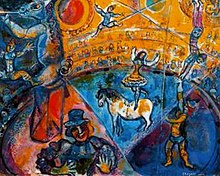
First of all, it is demonstrably the case that Chagall's windows are unmistakably Chagallian because Chagall simply paints this way.  Take a look at his "Circus" from 1967.  


Notice the dancer near the top frame in blue, and compare, for example, to the bird in the America Windows:


The figures show an amazing similarity.  The whimsy and "expansiveness" in Chagall is Chagall!  Keer misses the unremitting Monarchism in art, the thing that caused W. H. Auden to aver that if the process of making art were to be translated into politics, the result would be totalitarianism.  

Chagall's paintings look this way because Chagall exercised power over the craft to make it that way.  And here is the conundrum of art and politics:  there is so much bad art.  Similarly, some people's visions for a healthy society are just terrible.  It follows that just as there is good art, there is good political vision–vision which lays claim to us by the sheer suasion of its goodness.  Just as good art has a beauty that does not force the assent that it nevertheless rightly compels, there must be a kind of sociality whose goodness makes similar demands.  

All art is totalitarian; only some of that is great art.  But the great artist manages the paradox of totalitarian control and submission to the integrity of a subject as it suggests itself.  In practice, this comes out in the wash as the hand-clasping stream of changes that occur when the artist begins with one vision and sees that vision revised (by the artist, yes, but also not so) in the work's end.  A great artist will know how to let the subject suggest to him the best thing, a thing which he then executes with all the precision he is able to summon.  Great art is subordinate to the artist's recognition of the integrity of the thing being communicated.  That integrity simply cannot be seen except that the artist recognize it and then build it into the art.  And yet, the integrity that comes about in the art is precisely that which the artist has put there.  

I have seen this in dozens of my own poems.  It is very rarely the case that a good poem will be the result of a vision that never changes on the way.  The better the artist, the more free to humble himself and give to the piece that is forming.  If the artist's ego prevents that humility, the artist's will will be done, but the art will lack the integrity of a beautiful thing.  If the artist is humble, everything else (including the technique, to the best of the artist's ability) will follow in that train, for the form appropriate to a given subject is part of what ultimately gives the subject integrity.  

And it may be that the beautiful and the good come about by the same means.  If so, then democracy is a mere stopgap to prevent those whose visions for society are evil from ever having the paintbrush for long enough to do real damage.  In that sense, I endorse and celebrate it.  But it should not be concluded that democracy is therefore the best possible system.  In this sense, Ezra Pound was right–the city runs best when its best people are deployed doing what they are best at.  And the best governors should have the most power.  If there were a perfect governor, democracy would serve the people she governed terribly–for she should be empowered absolutely, and the goodness of her vision compels assent even if, humans being what they are, it cannot force it.  When that governor enacts a law, it would be right to assume that if I don't like it, I am wrong, just as I was wrong when, in my first encounter with it, I dismissed the poetry of Wallace Stevens.  

This sentiment is un-American.  But America is a society precisely built on the assumption that the good will never command the universal assent it deserves–that there can never be a such thing as the one mind of the body politic.  I'll take it in view of the foreseeable alternatives.  But I'd also love the opportunity to trade it in, and that is a helpful corrective to democratic triumphalism.  Indeed, the very opportunity for a better order would go unnoticed in a society where the good and the beautiful are divorced such that Chagall's unique vision can be chalked up to a democratic ideal.  

I'd love your thoughts on this.  Hit me up!


Friday, November 2, 2012

Faux-Mentum

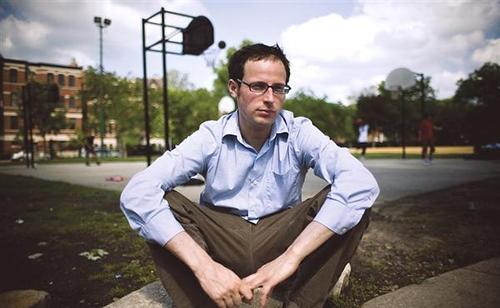
Props to Spaceman Spiff for pointing this article out to me.  I have been predicting (but only to myself--who wants to swallow that kind of pride?!?!) an Obama victory of around 320-330 electoral votes next week.  I did it with my gut.  This guy does it with Mathe-magic....er....matics.

In the wake of a certain kind of philosophical imperative to humility in the sciences, this article's subject does make you think a bit.  Perhaps the Empire is striking back.  Or are they the returning Jedi?

In either case, I definitely wish I had seen this earlier.  Might have made it safer to come out of the closet on my opinions.


Nate Silver’s Braying Idiot Detractors Show That Being Ignorant About Politics Is Like Being Ignorant About Sports

Friday, December 23, 2011

NEW POEM

Latte Art

…A double cappuccino to go—
your card is declined for lack
of cash.  I pull your shots anyway, and you
shift weight in denim curves, from left
to right, lip whispering Italian,

same as when I rang you yesterday. 
Always you order like that, and stir in
the rosetta ‘til it breaks into dashes, like one
of Joyce’s dialogues.  Kinch without teeth,
the pattern with no leaves, and the barista

knowing at the end of this, you will shift
from left to right, and stir, and leave
no image topping the tazza, nearest
your lips, where I have endeavored
with some skill to set it.  You only stir
a double cappuccino to go…